
The Software Split
When Infrastructure Survives and Everything Else Gets Questioned

Hello again!
With some space to breathe around the holidays, I’ve been thinking about my own tech stack lately. It’s changed a lot over the course of the year and not in the way you might expect. Rather than going down a path of adding more and more, I’m finding myself using less and less.
Pretty much to the point where I’m running almost everything on markdown files in a repository on GitHub with Claude Code as my engine. Outside of scripts I use and some n8n workflows I store, there’s hardly any traditional code.
This progression (or regression?) has had me thinking along something I’m noticing in the SaaS industry on a large scale and much more loudly when working with clients over the last few months. So I used today’s post to explore this change I’m noticing in a bit more depth.
Enjoy!
~ Harry
---
Before going solo, I spent five years at an enterprise SaaS company. We were building OKR software, and I was running OKRs internally using the very product we were selling to other companies. The ultimate dogfooding situation. And extremely meta, considering I was Chief of Staff.
For some companies, it was amazing. For others, it made it just okay. The gap between “this works well enough” and “this is exactly what we need” was always there. A missing % existed that needed to be filled.
It was a bit of a Goldilocks situation.
That’s why we had a Solutions Engineering team. It’s the same reason why Salesforce has them. Almost every major software company does. These are business-savvy people who are also technically capable, and their entire job is last-mile customization. Configuring the foundation to match how this specific company actually operates.
I didn’t think much of it at the time. It was just how enterprise software worked. And they were a remarkably talented and valuable team.
But.
Now I’m on the other side. Running a one-person consulting shop. And I’ve noticed the same pattern playing out, except now it’s everywhere, and I’m experiencing it personally.
The Solopreneur Version
When I started my business, I went through the standard tech stack journey. Asana first. Then ClickUp. Then Linear.
Each one was fine. None were bad products.
But none were quite right.
And this used to just feel like pickiness. Or maybe FOMO. Always thinking the next tool would be the one that finally clicked.
I didn’t spend precious time on any of this. I didn’t consider it business-critical. However, through this process, I realized I would never find what I needed, and the same would apply to assessments of other software.
Because once you’ve seen what AI can build - once you’ve used Claude Code for more than just coding, or built a workflow that is as effective and more than half the cost of a Clay.com subscription - you can’t unsee it. The bar permanently shifts.
Every piece of software gets evaluated against a new question:
Would I rather build this custom or pay for yours?
And increasingly, with those that are leaning into AI, the answer is “build it custom.”
Something I’ve Been Trying to Articulate
I’ve been sitting with this observation for a while now, and I think there’s a pattern emerging that I haven’t quite found the right words for.
Some software feels like plumbing. Email. Calendar. E-signatures. The data layer of a CRM. You just... use it. You don’t want to think about it, nor do you really have to most of the time. And most of all, you don’t want to build it yourself.
Building your own email server makes no sense. Neither does creating your own legally-compliant e-signature system. These are infrastructure. You outsource them and move on.
But everything else? Everything that sits on top of that infrastructure?
It’s starting to feel optional by the day. Challengeable.
Software now needs to justify its existence in a way it didn’t before.
Project management tools. KPI trackers. Dashboard builders. Status update generators. Internal tool builders. All of it is now competing against “I could probably build something that works better for my specific situation.”
And that’s a very different competitive landscape than “I could probably find a better vendor.”
The Attio Example
There’s a CRM called Attio that’s been gaining a lot of traction in the startup and VC world. And I think they’ve figured something out.
They’re a complete CRM solution. But they’re positioning themselves as infrastructure - a clean data layer with good enrichment that you build on top of. Their free tier gives you the foundation. Their paid tier scales with you. But the applications, the custom workflows, the specific ways your team interacts with the data? That’s on you.
And for most GTM teams today, that’s a perfect setup.
*This post isn’t sponsored by Attio but if you know someone on their team that’s willing to sponsor posts like this… open to intros!
They’ve essentially said: “We’ll be the plumbing. You build the house.”
Compare that to Salesforce or HubSpot, which try to be everything for everyone. Which means they need massive Solutions Engineering teams to bridge the gap between what they offer and what companies actually need.
I see Attio as having skipped that problem by not pretending they could solve it.
Why This is Happening Now
Two things changed.
Expectations shifted. The “art of the possible” has permanently expanded. When you know that AI can turn unstructured data into structured workflows, generic software feels inadequate. Not because it’s bad, but because you know it could be better if it were built for you specifically.
And building custom got easier. It used to require developers, budgets, timelines. Now someone who’s business-savvy and “dangerous with technology” can experiment their way to a working solution. Not perfect. Not production-grade. But good enough to replace the tool that was only getting them 80% there anyway.
The same dynamic I saw at Quantive (the OKR company) - where Solutions Engineering bridged the gap for enterprise clients - is now accessible to everyone. You just need to be willing to experiment.
The Pricing Challenge
It’s breaking how software companies charge, too.
Seat-based pricing made sense when value meant “access for your team.” Pay per user, everyone gets in, scale predictably.
But what happens when AI does the work instead of humans?
The more you automate, the fewer seats you need. Seat-based pricing and automation are then fundamentally at odds.
Seat-based pricing dropped from 21% to 15% of software companies in just twelve months. Hybrid models (mixing subscription with some sort of usage or outcome-based pricing) jumped from 27% to 41%.
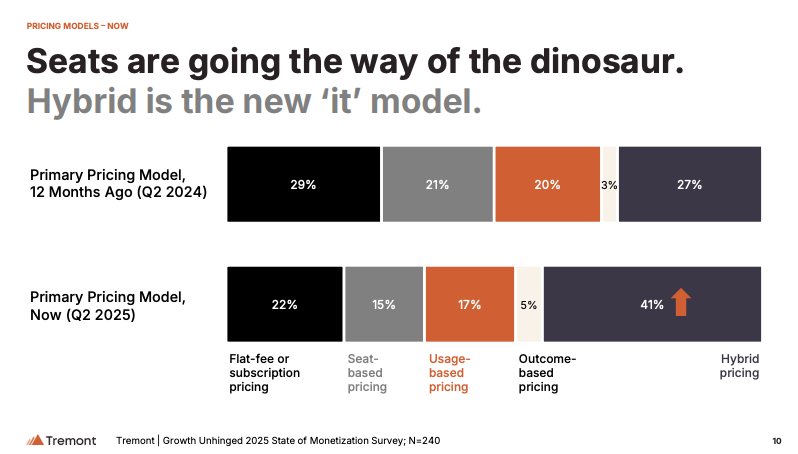
Everyone’s scrambling to figure out how to charge for value when the value isn’t “access” anymore. It’s “work actually done.” Or in the case of any OKR software platform, the pressure might be there to have clients pay based on how successful they are in achieving OKRs, based on how well your platform supports their strategy-execution efforts.
It opens up the question of what exactly customers are paying for.
The Cable TV Moment
This feels like the cable TV unbundling (and now re-bundling) saga.
We spent years unbundling. One tool for project management, one for communication, one for documentation, one for automation, one for analytics. We’re more bloated than ever.
And just like cable TV, people are starting to say: “Wait, why am I paying for all this? And it costs how much altogether?!?”
Except rather than rebundling into a new cable package that does it all, the teams I’m working with are building their operations into something simpler: foundation layer tools (the plumbing you don’t want to manage) plus custom applications (built by someone who understands the business and can get creative with technology).
What is Still TBD
I wrote a few weeks ago about how your playbook isn’t your advantage anymore. How AI is making it possible to compete on how you operate, not just what you do.
This feels connected. If operational approach is becoming a competitive advantage, then the tools that enable unique operational approaches are going to matter more than the tools that enforce standard playbooks.
But I’m not sure what that means for software companies in the middle. The ones that aren’t quite infrastructure, but aren’t quite compelling enough to beat custom alternatives.
Maybe they specialize harder. Maybe they become platforms that enable customization rather than products that deliver solutions. Maybe they just... struggle.
I don’t have a clean answer.
But the question that will matter more and more stays the same:
Would I rather build this custom or pay for yours?
For infrastructure - email, CRM data layers, e-signatures, payments - the answer is obviously “pay for yours.” The opportunity cost of building is too high.
For everything else? The answer is increasingly “let me think about it.”
And for a lot of solopreneurs, small teams, and even larger companies with the right people... the answer is becoming “actually, I’ll build it.”
That’s a different world than the one most software companies were built for. And I think we’re still in the early stages of figuring out what it means.